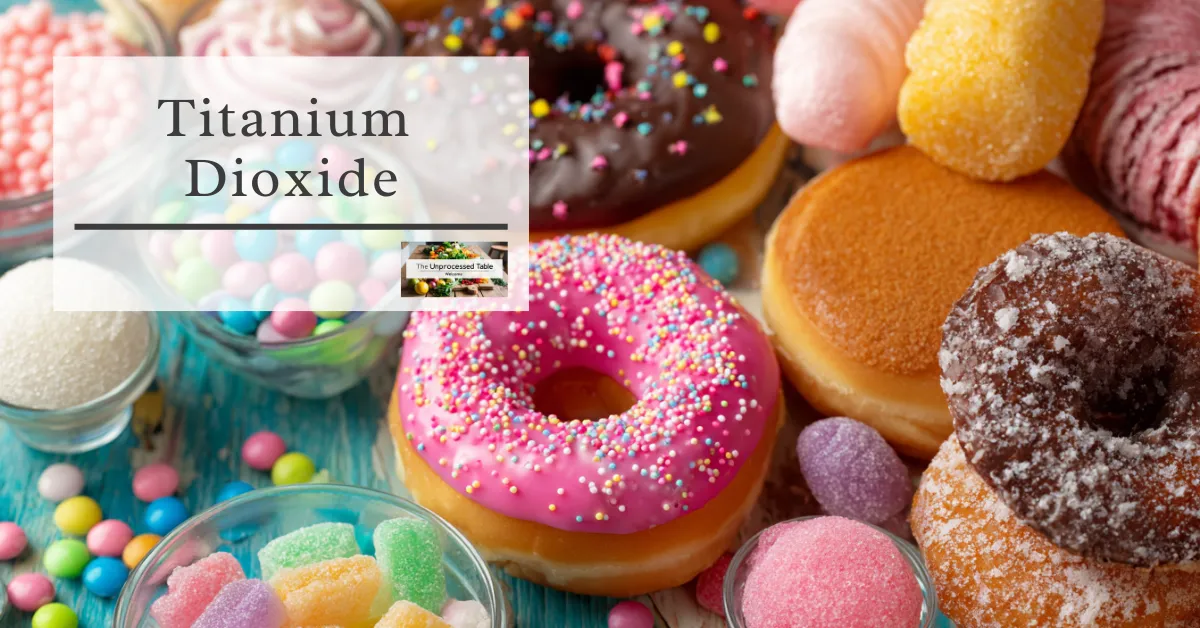
🧂 Titanium Dioxide in Food: Why It’s Used and Why It Deserves a Second Look

If you’ve ever wondered why some frostings look ultra-white…
why powdered donuts almost glow…
or why certain candies have that bright, opaque shell…
There’s a good chance titanium dioxide played a role.
This isn’t about fear.
It’s about awareness — and understanding what’s really creating that “perfect” white finish in processed foods.
🧪 What Is Titanium Dioxide?
Titanium dioxide (often listed as E171) is a white pigment used to make products look brighter and more opaque.
It is not added for flavor.
It is not added for nutrition.
It is purely cosmetic.
In food manufacturing, it helps:
• Make icing appear whiter
• Create uniform color in candies
• Brighten dairy products
• Prevent products from looking dull or gray
Outside the food world, titanium dioxide is widely used in:
• Paint
• Sunscreen
• Toothpaste
• Paper
Same compound. Different applications.
🍰 Where It Shows Up in Food
You’ll most commonly find titanium dioxide in:
Powdered donuts
Frostings and cake icings
Chewing gum
Coffee creamers
Candy shells
Some dairy-based desserts
It’s typically listed as “titanium dioxide” on ingredient labels.
If a processed food looks unusually bright white, it’s worth checking.
🌍 Why Some Countries Have Banned It
In 2022, the European Food Safety Authority concluded that titanium dioxide could no longer be considered safe as a food additive due to concerns about potential genotoxicity (possible DNA damage at a cellular level).
As a result, the European Union banned its use in food.
In the United States, the U.S. Food and Drug Administration still permits titanium dioxide in food within regulated limits (up to 1% by weight of the food).
This difference highlights something important:
Food regulations evolve — and different regions interpret emerging science differently.
🔬 What Are the Concerns?
The conversation around titanium dioxide centers on:
• Particle size (especially nano-sized particles)
• Accumulation in the body
• Potential cellular effects over time
Research is ongoing. Some studies suggest that nanoparticles may behave differently in the body than larger particles.
For everyday consumers, the key takeaway isn’t panic — it’s informed choice.
🥣 A Real Food Perspective
Here’s the honest question:
Do we actually need ultra-white frosting?
Or are we just used to it?
Before industrial food coloring agents, frosting was cream-colored.
Sugar wasn’t blindingly bright.
Food looked… natural.
When we shift toward whole, minimally processed ingredients, titanium dioxide simply disappears — because real food doesn’t need cosmetic brighteners.
🌿 Simple Swap Ideas
Instead of:
❌ Bright white store-bought frosting
Try → ✔ Homemade buttercream (naturally off-white, made with butter + powdered sugar)
❌ Candy-coated treats
Try → ✔ Dark chocolate with clean ingredient labels
❌ Ultra-white coffee creamer
Try → ✔ Organic half-and-half or coconut milk
You don’t need synthetic whiteners to enjoy sweetness.
🌸 Flora Flash
In the early days of commercial baking, “whiter” meant “purer” in marketing language. Bright white bread symbolized refinement and status.
Today, we know that color doesn’t equal quality.
Sometimes cream-colored is exactly how food is supposed to look.
🧘🏽♀️ The Gentle Takeaway
Titanium dioxide isn’t about drama.
It’s about awareness.
It’s a reminder that:
• Not every ingredient exists for nourishment
• Some exist purely for appearance
• And reading labels is one of the simplest acts of empowerment we have
You don’t have to overhaul your pantry overnight.
But the next time something looks suspiciously perfect…
Flip it over.
And see what’s making it glow. ✨


